en
- de
- en

Centuries of Exchange between Poland and the Islamicate World
When thinking about Islamic art, Poland is probably not the first place that comes to mind. But it might come as a surprise that Poland actually had a vast amount of contact with Islamicate world throughout the centuries. First of all, Poland shared a direct border with a Muslim-ruled state for more than 300 years. From the late 15th to the late 18th century, Poland – or to be precise, the Crown of the Kingdom of Poland and the Polish-Lithuanian Commonwealth – was a neighbour to the Ottoman Empire. Relations between the two were not always peaceful – the 17th century in particular was full of Polish-Turkish wars – but this physical proximity directly influenced Polish culture and art.
Poland-Lithuania’s often difficult relationship with the Ottomans influenced its ties with another Islamic power, that shared its rivalry with the Ottoman Empire: Safavid Persia. Both countries bordered the Ottoman Empire, just from opposite sides. So, despite being separated by thousands of kilometres, Polish kings and Persian shahs exchanged envoys who travelled between Kraków and, later, Warsaw and Isfahan.
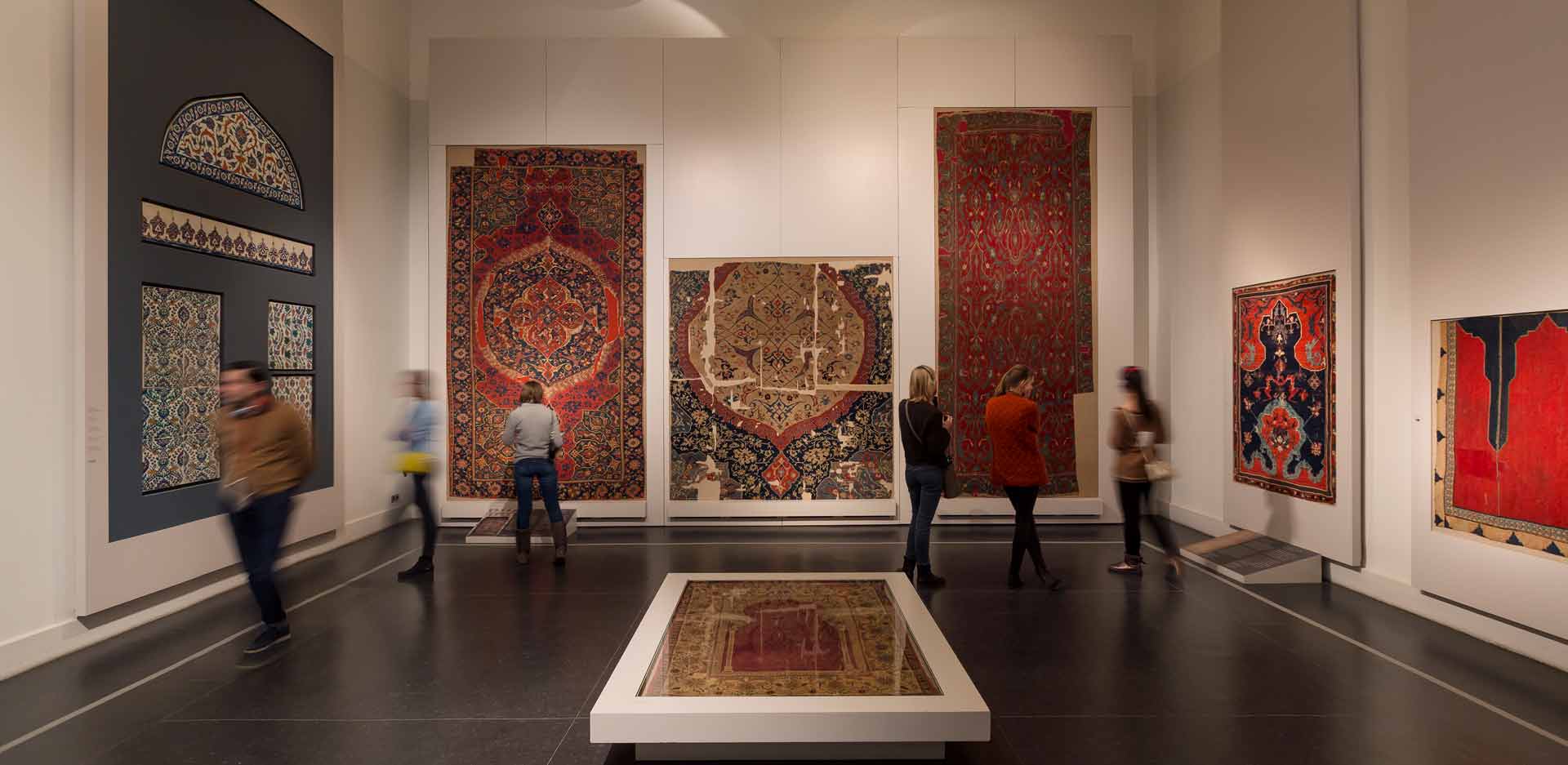
These connections were not limited to politics. Luxury objects travelled between the Islamicate world and Poland through trade, diplomatic gifts, commissions and war. People also played an important role in these exchanges, including Polish-Armenian merchants, diplomats and Muslim communities such as the Lipka Tatars. The collections of the Museum for Islamic Art in Berlin preserves several objects that allow us to trace these different connections between Poland and the Islamicate world.
An 18th century map of the Ottoman Empire, showing its provinces and tributary territories across Europe, Asia and Africa.
Sarmatism: Myth, Identity and Culture
There is one very specific context to Poland’s relations with the two great Islamic empires, the Ottomans and the Safavid Persia, Sarmatism. Sarmatism was an ideology that emerged among the Polish nobility (szlachta), based on the myth that they were descendants of the Sarmatians – an ancient, warlike Iranian tribe. Standing in sharp contrast to Western European fashion, this distinctive look was used to emphasize their unique identity.
This imaginary identity had a very real impact on traditional Polish culture and art between the 16th and 18th centuries. Elements of traditional Sarmatian clothing and gear were directly influenced by Ottoman and Persian aesthetics. The szlachta wore long robes (żupan and kontusz), tied them with long sashes, and carried curved sabres (karabela).
Sarmatism created a massive demand for Islamic goods, which became status symbols for the Polish ruling class. This had a direct impact on trade routes, in which Polish-Armenian merchants played a vital role.

Trade and the Movement of Luxury Objects
From the late thirteenth century onwards, knotted carpets from the Islamicate world were among the most highly prized luxury objects in Europe. Imported through extensive trade networks, they were sought after by collectors and came to signify wealth and social standing. In Poland, the popularity of these textiles reached its heights between the sixteenth and eighteenth centuries. Polish nobles valued carpets, silks and other luxury textiles from Ottoman, Persian and Caucasian workshops, using them in residences and ecclesiastical interiors as well as for ceremonial occasions.
Across Europe, such textiles functioned as markers of status and cultural sophistication. Their presence in visual culture is evident in European paintings, particularly from the Italian Renaissance, where they appear as well-integrated elements within interior scenes. In some cases, carpets became so closely associated with Polish patronage that Western European sources referred to certain examples as “Polish carpets,” even when they had been woven in workshops across the Islamicate world.

Trade was not the only way objects reached Poland. Diplomatic missions carried valuable gifts between courts, while military conflicts could bring objects into Poland as spoils of war. After major conflicts against the Ottoman Empire, like the Battle of Vienna in 1683, Polish forces captured immense quantities of military equipment and camp gear, including silk tents, horse trappings, sabres, and shields.
Through these different routes, objects from the Islamic world became part of Polish material culture, sometimes retaining their original associations and sometimes acquiring new meanings in their new surroundings.

Diplomacy and the Ottoman Court
Relations between Poland and the Ottoman Empire were marked by alternating periods of conflict and cooperation. The two neighbouring powers engaged in warfare, diplomacy, trade and cultural exchange over several centuries.
These exchanges influenced the tastes of the Polish nobility. Inspired in part by Sarmatism, nobles adopted elements of Ottoman dress, material culture and courtly customs. Imported textiles, carpets, weapons and ceramics became treasured possessions and visible symbols of prestige. Ottoman art is the most widely represented category of Islamic art in Polish collections, reflecting centuries of trade, diplomatic gift-giving and the acquisition of objects as spoils of war.
Iznik Ceramics and a Polish Diplomat
In the second half of the 16th century, workshops in Iznik produced the most celebrated ceramics in the Ottoman world. Their distinctive designs, vibrant colours and the high technical quality, were admired within and beyond the empire. Through commercial networks, Ottoman ceramics reached European collections, where they were appreciated as luxury objects.
Among its Iznik collections, the Museum for Islamic Art preserves one plate that has a special connection to Poland. This remarkable Iznik plate bears the coat of arms of Andrzej Taranowski, a Polish diplomat and royal secretary, who is known for his significant diplomatic missions and first-hand travel accounts of the Ottoman Empire. His reports provided rare insights into the politics and military landscapes of the Ottoman frontier and the Danubian principalities.
Taranowski visited Constantinople (today’s Istanbul) four times on diplomatic missions. In 1569, King Sigismund II Augustus sent him to the Ottoman capital, where he successfully negotiated with the Grand Vizier and Sultan Selim II. From 1574 to 1575, Taranowski spent 20 weeks in Istanbul to negotiate the ratification of a peace treaty with the new Sultan, Murad III. Finally, in 1579, he undertook his last diplomatic mission to maintain peace with the Ottomans.
Taranowski’s coat of arms on the Iznik Plate at the Museum
The Iznik plate in the museum collection is decorated with alternating red and blue floral motifs. On the upper part of the rim, are Taranowski’s stylised coat of arms and the initials A and T, accompanied by a Christian cross. On closer inspection, there are some differences between the heraldic shield on the plate and the Polish Belina coat of arms belonging to Taranowski. Rather than reproducing the coat of arms exactly, ornaments known in Ottoman art, such as feather leaves and a small flower in the centre, are used instead. The three horseshoes arranged around a silver crucifix on a blue shield on Taranowski’s coat of arms are positioned here on the left side of the emblem. Instead of the horseshoes, crescents are depicted, again a common motive in Ottoman art.
It is clear, that the ceramicists from Iznik adopted the motifs used on the Polish emblem to a new arrangement that incorporated elements more common to their ornamental repertoire. We believe that this valuable Iznik plate may have been presented to Taranowski as a diplomatic gift during his time in Istanbul for peace negotiations in 1574-75.
Gift exchange with high-ranking diplomats was a very common practice at the Ottoman court. Valuable gifts were expected from foreign diplomats. Furs and hunting dogs were higly valued Polish gifts. In return, the Sultan gave caftans as robes of honor, silk fabrics, carpets and perhaps Iznik ceramics to high-ranking diplomats.
This Iznik plate provides a tangible insight into the material exchanges that accompanied diplomatic relations between Poland and the Ottoman court and was for Taranowski certainly a valuable souvenir of his missions to Istanbul.
Persia: Polish Patrons in Safavid Iran
Unlike its often tense relationship with the Ottoman Empire, Poland fostered warm and admiring ties with Safavid Persia who ruled from the 16th to the 18th century. Shared opposition to Ottoman power made Persia a strategic ally of the Polish-Lithuanian Commonwealth, despite the great distance separating the two states.
These connections also shaped Polish tastes and collecting practices. Persian carpets, textiles and weapons became prized possessions among the Polish nobility. For a Polish nobleman (szlachcic), weapons, particularly the sabre, were an important mark of status. Polish monarchs and magnates also commissioned Persian objects to suit their personal tastes and heraldic traditions, and royal emissaries travelled to Persia to order custom-made carpets.
One of the best-known figures in this history was Sefer Muratowicz, a Polish-Armenian merchant sent to Persia by King Sigismund III Vasa (Zygmunt III Waza) in 1601. Travelling through Moldavia and the Ottoman Empire, Muratowicz reached Kashan, a major centre of royal Safavid carpet production during the reign of Shah Abbas I.
In his travel account, Muratowicz described the production of custom-made carpets woven with silk and metal threads, recording details about their materials and costs. His mission provides a direct link between the Polish court and Safavid workshops, and is closely associated with the history of the carpets known as “Polonaise” carpets.
These luxurious Persian textiles were sometimes decorated with coats of arms commissioned by Polish patrons. In the 19th century, European art historians initially believed that such carpets had been woven in Poland, before their Persian origins were recognised. The name “Polonaise” nevertheless remained, reflecting the close association these carpets had developed with Poland.
Through commissioned carpets, silk sashes, weapons and other luxury goods, Poland and Safavid Persia built artistic connections that extended far beyond their geographical distance. Persian carpets also retain a strong association with quality and luxury in Poland today.

Kashan Tapestries: Persian Textiles in Berlin Collection
The Museum for Islamic Art in Berlin holds two exceptional late 16th-century silk weavings from Kashan, a major centre of Safavid textile production. Their fine silk and metal-wrapped threads reflect the luxury and technical sophistication of Persian textiles during this period.
Both tapestries were once thought to have been made in Poland because they were associated with a group of luxury textiles that includes examples bearing the coats of arms of Polish Sigismund III Vasa. However, their provenance reflects a similar history to that of Sefer Maratowicz's mission to commission carpets for the Polish court. Nobility from all over Europe favoured these delicate textiles and carpets.
A Tapestry from the Collection of Empress Friedrich
This exceptionally fine silk tapestry was probably produced in a royal court workshop. Its luxurious materials suggest that it was intended as a prestigious courtly object or royal gift.
At its centre, a medallion depicts a dragon and phoenix. These motifs originated in East Asian artistic traditions and became part of Islamic art through centuries of cultural exchange. Together with the stylised animals and elaborate ornament, they reflect the diverse influences that shaped Persian artistic traditions.
The tapestry later belonged to Empress Friedrich (Victoria, 1840–1901), wife of Emperor Friedrich III of Germany. Following her husband's death, she lived at Friedrichshof Castle in Kronberg im Taunus, where the textile may have formed part of her art collection. Over time, its originally vivid colours faded because silk is sensitive to light.

The Cassirer Tapestry
This silk weaving has a long collecting history. It was documented in the collection of industrialist and art collector Mathieu Thierry-Mieg in Mulhouse before 1877, before later entering the collection of Alfred Cassirer in Berlin. It was loaned to the Detroit Institute of Arts in 1949 and formally acquired by the Museum for Islamic Art in 2023. Its twin is held at the Metropolitan Museum of Art in New York.
The two textiles in the Museum for Islamic Art's collection offer a glimpse into the history of Safavid luxury weaving and the collecting of Persian textiles in Europe.

Polonaise Carpets
The Museum for Islamic Art in Berlin holds three carpets known as Polonaise carpets (inv. nos. KGM 1884,929, I.23 and I.27/68). Produced in Safavid Iran, most probably in and around Isfahan, they were made for European royal and princely courts. Some were commissioned by European patrons, while others were presented as diplomatic gifts.
These carpets were among the most luxurious textiles of their time. They were woven from fine silk, with gold- and silver-wrapped silk threads creating a shimmering surface. Their rich colours and elegant floral and leaf motifs reflect the high level of craftsmanship achieved in Safavid workshops.
Much of their original brilliance has diminished over time. The metal threads have tarnished or corroded, while the light-sensitive silk has faded. Nevertheless, the carpets still convey something of the splendour that made them prized possessions at European courts.
In the 19th century, European art historians initially believed that the carpets had been woven in Poland, before their Persian origins were recognised. The Polonaise carpets are a striking example of the artistic connections between Safavid Iran and Poland.
When “Polish” Does Not Mean Polish: The Ushak Carpets
For several decades, the origins of two Medallion Ushak (a city in present day Turkey) carpets have been debated: one in the collection of the Museum for Islamic Art in Berlin (inv. no. I.4928), the other in the Wawel Castle collection in Kraków (inv. no. 240).
Both carpets bear the coat of arms of the Polish nobleman Krzysztof Wiesiołowski (1580–1637), linking them to Poland. But does this mean they were made there?
In 1954, Polish art historian Tadeusz Mańkowski argued that the two carpets were made in Poland, distinguishing them from the Polonaise carpets, which were produced in Persian workshops. His attribution was later followed by Friedrich Spuhler, who also classified the Berlin carpet as Polish. However, comparisons with securely attributed Anatolian Ushak carpets have challenged this interpretation, as their materials, weaving techniques, colours, and other features show strong similarities.
The coat of arms itself provides another intriguing clue. On the Berlin carpet, the heraldic design appears mirrored. If the carpet had been produced in Poland, such an error might have been more easily noticed and corrected. A weaver working in Anatolia (present day Turkey), on the other hand, may not have been familiar with the original Polish heraldic design.
This does not mean that Polish carpet production should be ruled out. Written sources confirm that carpet workshops existed in Poland, including in Zamość, Brody and Sokołów. The two Medallion carpets, however, differ considerably from securely identified examples of Polish production.
The question therefore remains open. Their material, technical, and stylistic characteristics currently point more convincingly towards Anatolian/Turkey production, possibly from a smaller workshop. Further technical analyses of the dyes, fibres, and weaving, and provenance analyses are needed to test this hypothesis.
A Polish Carpet in the Museum for Islamic Art?
Could there be a carpet made in Poland in the collection of the Museum for Islamic Art in Berlin?
In 1883, the Kunstgewerbemuseum acquired a small carpet that has been part of the Museum for Islamic Art’s collection since 1956. Unlike the carpets discussed above, it appears to be of European origin. Its knotting technique and materials offer important clues about where it may have been made.
Its precise origin, however, remains uncertain. The original inventory card records “Poland?” as the provenance, while a later handwritten addition suggests Spain. There are arguments in favour of both possibilities. The border ornament resembles that of Spanish carpets, while the linen foundation and unusually thick threads point more strongly towards a Polish origin.
A direct comparison with securely attributed Polish carpets has not yet been possible because the Berlin collection contains no comparable examples. A systematic examination of Polish carpet collections could therefore provide important evidence.
The carpet may ultimately prove to be the only Polish carpet in the Museum for Islamic Art’s collection. For now, its origin remains an open question, with its materials and technique offering clues but no definitive answer.
Muslim and Armenian Communities
The connections between Poland and the Islamicate world were shaped not only by trade, diplomacy and the movement of objects, but also by communities whose lives bridged different cultural and religious traditions.
The Lipka Tatars, a Muslim community that settled in the lands of the Polish-Lithuanian Commonwealth from the 14th century onwards, became an integral part of Polish society while maintaining their Islamic faith. They served in the military, including as cavalry, and developed communities whose religious and cultural traditions remain visible today in historic mosques, manuscripts and decorative arts. Active Tatar communities continue to live in eastern Poland.
Armenian communities, predominantly Christian, also formed an important part of the cultural landscape of the Polish-Lithuanian Commonwealth. Thanks to their multilingual abilities and cultural fluency, Armenians also frequently served as interpreters at courts. Eventually, they established local workshops inside the Commonwealth, producing Persian- and Ottoman-style textiles, sashes, and decorative items that blended Islamic aesthetics with Polish tastes.
Outlook
Through trade routes, diplomatic contacts, Muslim communities such as the Tatars, and the tastes of the Polish nobility, Islamic art became woven into the cultural fabric of Poland itself. These connections are still visible today in the museum collections of Poland, and also in the objects at the Museum for Islamic Art in Berlin. The visitors can look forward to the display of the objects from the Museum for Islamic Art with fascinating stories and connection to Poland in the permanent exhibition from June, 2027.
Co-Authors
Dr. Magdalena Pinker: Chief Curator of the Department of Oriental Art at the National Museum in Warsaw, and Assistant Professor at the Department of Arabic and Islamic Studies in the Faculty of Asian and African Cultures at the University of Warsaw.
Dr. Deniz Erduman-Çalış: Curator, Museum für Islamische Kunst, Berlin
Anna Beselin, M.A.: Curator Alwaleed & Conservator for Carpets/Flatweaves, Museum für Islamische Kunst, Berlin
Edited and prepared for the Online Portal by Farwah Rizvi and Cornelia Weber.
Related stories
Crossroads Iran
Crossroads Iran highlights narratives with Iran at the crossroads of cultural exchange and artistic influence. This initiative connects museum objects with archival photos, through stories and videos.